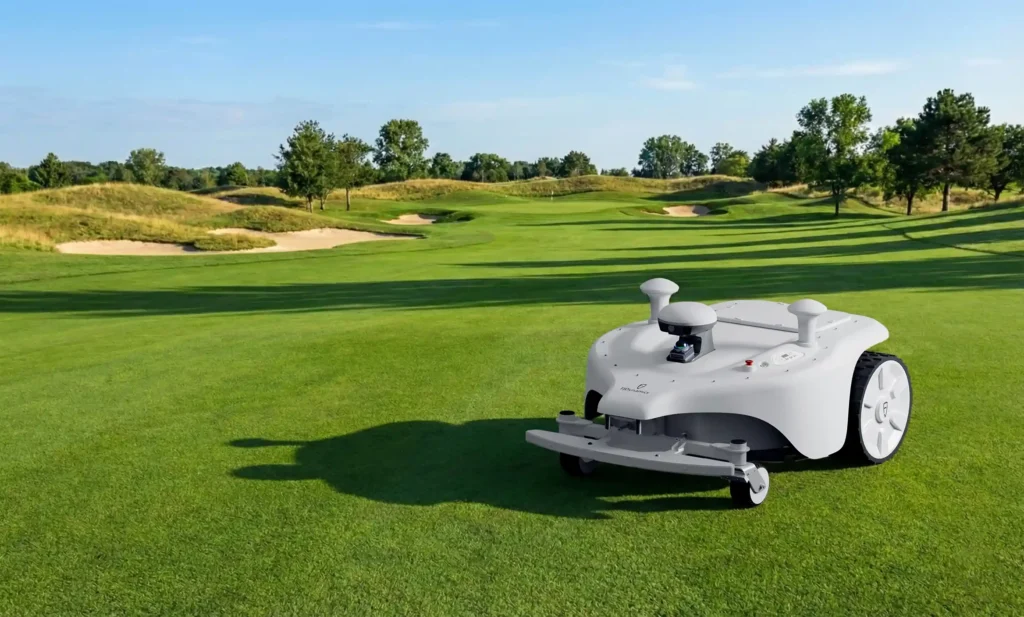
Managing large landscapes has always required significant time, labour, and operational costs. From sports complexes and parks to golf courses and public spaces, maintaining turf at scale can be challenging. Autonomous mowing technology is now transforming how these environments are maintained, and the FJD Titan Robotic Mower is leading that change.
The biggest challenge in large-scale landscaping is consistency. Traditional mowing depends heavily on operators, scheduling, and manual labour availability. Autonomous systems remove much of this unpredictability by delivering repeatable, highly accurate mowing performance every day.
The FJD Titan is specifically designed for large commercial landscapes. Equipped with RTK, LiDAR, and Vision navigation systems, it can operate safely and efficiently across complex environments while maintaining precise mowing paths and obstacle avoidance.
One major advantage of robotic mowing is labour optimisation. Landscaping teams often spend large amounts of time on repetitive mowing tasks. By automating these responsibilities, teams can focus on higher-priority maintenance work such as turf improvement, landscaping design, irrigation systems, and customer-facing services.
The Titan’s large cutting width and high-capacity operation make it ideal for covering extensive areas quickly and efficiently. Sports facilities and golf courses can maintain consistent turf presentation without relying solely on manual mowing crews.
Another important benefit is operational flexibility. Autonomous mowers can work during off-hours or overnight, helping maximise daytime field availability. Quiet electric operation also reduces disruption in public environments.
Safety and technology integration are central to the Titan’s design. Advanced sensors and intelligent obstacle detection help ensure safe operation around people, objects, and infrastructure. Remote monitoring systems also allow operators to manage multiple mowing zones and track performance through connected software.
Sustainability is another driving factor behind the adoption of robotic mowing technology. Electric systems reduce fuel consumption and emissions while helping organisations meet environmental goals and reduce operating costs over time.
As landscaping operations continue evolving, automation is becoming less of a luxury and more of a competitive advantage. Businesses and facilities that adopt autonomous technology early are better positioned to improve efficiency, reduce labour pressures, and maintain higher standards of turf presentation.
The FJD Titan Robotic Mower is more than a maintenance tool — it is a complete shift toward smarter, technology-driven landscaping management.